Visual Materials
Pace Setter House #3 of 1950

You might also be interested in
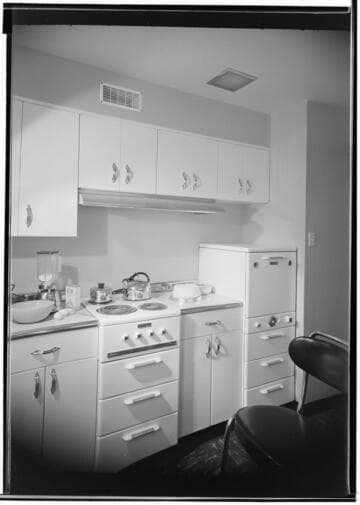
Pace Setter House #1 of 1950
Visual Materials
Interior views of a house built by the David D. Bohannon Organization in the Hillsdale subdivision. According to House Beautiful this house was decorated in the "Contemporary" style.
photCL MLP 1799
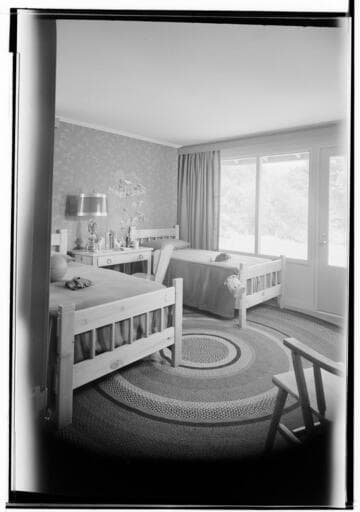
Pace Setter House #2 of 1950
Visual Materials
Interior views of a house built by the David D. Bohannon Organization in the Hillsdale subdivision. According to House Beautiful, this house was decorated in the "Ranch" style.
photCL MLP 1799
![[Rancho Rinconada model houses: Traditional model]](/_next/image?url=https%3A%2F%2Frail.huntington.org%2FIIIF3%2FImage%2F22APN4KZEP8Y%2Ffull%2F%5E360%2C%2F0%2Fdefault.jpg&w=750&q=75)
[Rancho Rinconada model houses: Traditional model]
Visual Materials
Exterior details and interior views of model house decorated in a traditional style. Emphasis on views of the patio.
photCL MLP 2524
Image not available
House Beautiful: Pace Setter Houses
Visual Materials
The House Beautiful Pace Setters Houses subseries consist of 1,494 black-and-white negatives, color transparencies, black-and-white prints, and color prints, circa 1948-1961, created by Maynard L. Parker and documenting House Beautiful's Pace Setter House Program. House Beautiful editor Elizabeth Gordon began the Pace Setter House program in 1946 to oppose the International Style of design embodied by architects such as Le Corbusier, Walter Gropius, and Ludwig Mies Van der Rohe. Pace Setter houses were intended to highlight a modern American architecture that emphasized craft and regionalism. The program continued until 1965, featuring 17 houses by architects including Cliff May, Henry Eggers, Walter Wilkman, Alfred Browning Parker, Harwell Hamilton Harris, and Roger Rasbach. Included are the 1948 Pace Setter House designed by Cliff May, the 1949 house designed by Emil Schmidlin, the three Pace Setter Houses of 1950 built by the David D. Bohannon Organization, the 1951 Pace Setter designed by Julius Gregory, the 1953 house designed by Henry Eggers, the 1955 house designed by Harwell Hamilton Harris, the 1956 house which was a remodel designed by Morgan Stedman, the 1958 house designed by Vladimir Ossipoff, and the 1961 house designed by Roger Rasbach.
Subseries II.3.
![Pace Setter House of 1961 [Halff, Hugh, residence]](/_next/image?url=https%3A%2F%2Frail.huntington.org%2FIIIF3%2FImage%2F22APN4KOCABI%2Ffull%2F%5E360%2C%2F0%2Fdefault.jpg&w=750&q=75)
Pace Setter House of 1961 [Halff, Hugh, residence]
Visual Materials
Interior and exterior views of a large house including the semi–enclosed patio or garden room. Also includes images of innovative design elements like the sliding roof, centralized light switches and climate control elements. Also includes decorative details such as the embroidery work of Martha Mood and pewter hardware by Ernst Auerbach.
photCL MLP 1805
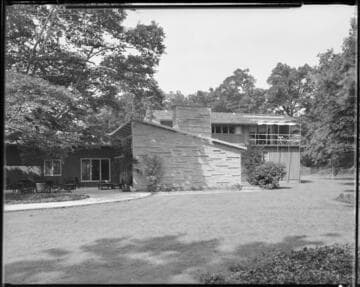
Pace Setter House of 1949
Visual Materials
Interior and exterior images of a house including its outdoor living areas, maid's quarters, entertaining, and work areas.
photCL MLP 1798