Manuscripts
Booke of good condicions : [manuscript]

You might also be interested in
![Wycliffe materials : [manuscript]](/_next/image?url=https%3A%2F%2Frail.huntington.org%2FIIIF3%2FImage%2F22APN4K2OW_P%2Ffull%2F%5E360%2C%2F0%2Fdefault.jpg&w=750&q=75)
Wycliffe materials : [manuscript]
Manuscripts
ff. 19v-103v. Psalter, Wycliffe translation. Incipit: Blessid is þe man þat ȝede not in þe coun[sel] of wickide men. Explicit: herie ȝe him in cymbals of iubilacioun: ech spirit herie þe lord. English. The psalter is introduced by four prologues of which the first and the fourth attribute authorship to Richard Rolle; the prologues and psalter are preceded by a section of Deuteronomy (beginning defectively), followed directly by Baruch ending defectively, and a section from Tobias (beginning defectively). ff. 103v-113. Canticles, Wycliffe translation. Incipit: Lord I schal knowleche o þee for þou were wrooþ to me. English. Old and New Testament Canticles, followed by the Quicumque vult salvus esse, and the litany. ff. 113-117. Psalms, excerpts, Wycliffe translation. Incipit: God seiþ þi his profete, my people parseyue ȝe my lawe, bowe ȝoure eere into þe wordis of my mouþ. Explicit: Schal not he heere þat plauntide þe eere, eiþer biholdiþ not he þat made þe iȝe, ps, lxxxxiii. English. Twenty-three excerpts from the psalms in the later Wycliffite version, apparently unique. ff. 117-121v. Rubric: Here bigynneþ ieroms sautir, Lord god vouchesaaf to take up þese psalmes þat ben halowid to þee, which I synful & vnworþi desire to seie in worschip of þi name. Incipit: Lord parseyue þou my wordis with þin eeris. Explicit: þat glorie & honour and worschip be to god þe fadir and to þe sone and to þe holy goost in alle worldis of worldis. Amen. Here eendiþ Ieroms sautir. English. See A. C. Paues, A Fourteenth-Century English Biblical Version (Cambridge 1902) lxiii-lxiv for the prayer and a discussion of the English text of the psalter of St. Jerome; complete Latin text in HE, 116-22. ff. 122-145. [Clement of Llanthony] Oon of foure. Incipit: In bigynnynge or first of alle þingis was goddis sone & goddis sone was at god. Explicit: I deeme þat þe world schal not take þe bookis þat schulen be writen. Rubric: Here bigynneþ þe gospel on cristemasdai at hiȝ masse. English. Oon of foure, the English translation of Clement of Llanthony's Concordia Evangelistarum (see Brit. Lib., Harley 1862, Roy. 17.A.XXVI and Roy. 17.C.XXXIII), normally in 12 parts, but here only Parts 1-2, 11-12; breaks in the text of 2 leaves after f. 132 and of 8 leaves after f. 134. ff. 145-146. Rubric: Here bigynnen þe xii articlis of oure bileeue. Incipit: The firste article of oure bileeue is þat god is oo substaunce & þre persones in himsilf. Explicit: for þe word of god to fulfille is liif & ioie wiþouten eende. Amen. English. Twelve articles of faith and seven sacraments. ff. 146v-147. Rubric: Here bigynneþ þe gospel of ascencioun day. Incipit: And þe enleuenþe disciplis wente into galilee in to an hil. Explicit: & aftir to regne wiþ oure lord ihesu crist & sauiour & hise holy seyntis into worldis of worldis. Amen. English. Gospel pericopes from Matthew and Mark. ff. 147v-150. [Poem]. Incipit: Blessid god souereyn goodnesse/ mercy to me thy synfull creature. Explicit: with angellis & senttis synggung in kynd/ Sanctus Sanctus Sanctus lord god with out ynd. English. IMEV 532; C. Brown, Religious Lyrics of the XVth Century (Oxford 1939) 86-89, from this manuscript. Followed on ff. 150v-151 by the table of contents, added towards the middle of the fifteenth century in a secretary script; ff. 151v-152v blank.
mssHM 501
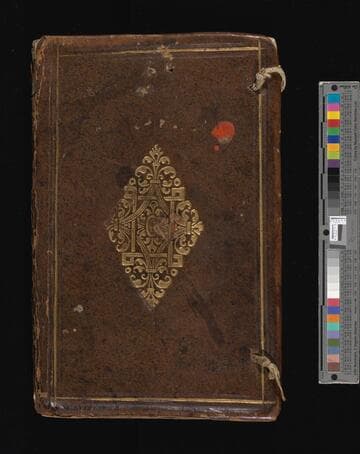
Booke of receipts: manuscript, 1695, November
Manuscripts
Volume contains medical and culinary recipes. Note on first page: "Magdalen Coward Her Booke of Receipts Made November, 1695."
mssHM 88
![Life of St. Norbert : [manuscript]](/_next/image?url=https%3A%2F%2Frail.huntington.org%2FIIIF3%2FImage%2F22APN41AE2WS%2Ffull%2F%5E360%2C%2F0%2Fdefault.jpg&w=750&q=75)
Life of St. Norbert : [manuscript]
Manuscripts
Part 1. ff. 1-59v. [John Capgrave]. [Life of St. Norbert]. Incipit: There was a man sumtyme dwelling here/ As our book seith in þat ilk same tyde. Explicit: The freris name þat translate þis story/ Thei called Ion capgraue whech in assumpcion weke/ Made a ende of all his rymyng cry/ The ȝere of crist oure lord witȝ outen ly/ A thousand four hundred & fourty euene/ Aftyr þis lyf I pray god send us to heuene. Feliciter. English. The text is precede by a prologue that begins,"Ioye grace & pees loue feith & charite/ Euyr rest up on ȝour goodly religious breest..." and ends with an Envoy that begins," Go litil book to hem þat wil þe rede/ Sey þe were made to þe abbot of derham..." IMEV 1805. C. L. Smetana, ed., The Life of St. Norbert by John Capgrave O.E.S.A. (1393-1464). Pontifical Institute of Mediaeval Studies 40 (Toronto 1977) from this manuscript, evidently autograph (witness the hand and the"signature" on f. 59v,"Feliciter" with the trefoil); interlinear corrections in the author's hand. For discussions of the identity of the copyist, see P. J. Lucas,"John Capgrave O.S.A. (1393-1464) Scribe and 'Publisher,'" TCBS 5 (1969) 1-35 ; E. Colledge,"The Capgrave 'Autographs,'" TCBS 6 (1974) 137-48 ; Smetana, op. cit., 5-7. On the linguistic forms in HM 55, see E. Colledge and C. Smetana,"Capgrave's Life of St. Norbert: Diction, Dialect and Spelling," Mediaeval Studies 34 (1972) 422-34. Part 2. f. i recto-verso. [Breviary, fragment]. Incipit: //pulus. Numquid aliud iudex nunciat aliud preco clamat. An simul et odisse possumus et diligere. Explicit: Nam et ihesus vester dum hec predicaret iudei illum crucis patibulo affixerunt. Andreas respondit O si//. Latin. Unfinished leaf of a breviary from the end of a homily of Gregory (PL 76:1275 ) in the common of a martyr, presumably for Saturninus through part of the 4th lesson for Andrew.
mssHM 55
Image not available
Commonplace book. Parliament: manuscript
Manuscripts
A Booke Conteyning the whole Passages of the last Parliament ended the 10th daie of March 1628 [with] other materiall passages that happened from the yeare 1623 untill the end of the Parliament in the Yeare 1628[/29].
mssHM 213
![Prose and poetry in English : [manuscript]](/_next/image?url=https%3A%2F%2Frail.huntington.org%2FIIIF3%2FImage%2F22APN4KG2CQF%2Ffull%2F%5E360%2C%2F0%2Fdefault.jpg&w=750&q=75)
Prose and poetry in English : [manuscript]
Manuscripts
ff. 1-32. [Richard Rolle, attributed to]. [Contemplations of the Dread and Love of God]. Incipit: Whi ech man schulde desire to love god, Amonge alle creatures whiche god of his endeles myȝte made. Explicit: whiche be þe techinge of almiȝti god have write to þe þes fewe wordes in helpinge of þi soule. Ardeat in nobis domini fervor amoris. English. Text here preceded by a chapter list (labelled a-z, the last entry with no sign:"This schort pistil þat folweþ is deuided in sundri materes ech mater be himself in titlis as þis kalender shewes . . .), and by a prologue (In þe begynnynge and endynge of alle goode werkys: worshipe and þonkynge be to almyȝti god makere and byere of all mankind . . .). Contemplations of the Dread and Love of God (title used in Wynkyn de Worde's edition, 1506), or Fervor amoris, as on f. 33v, including the following three texts, Tractatus de quattuor gradibus amoris. P. S. Jolliffe, A Check-list of Middle English Prose Writings of Spiritual Guidance. Pontifical Institute of Mediaeval Studies, Toronto, Subsidia Mediaevalia 2 (Toronto 1974), H.15. C. Horstman, ed., Yorkshire Writers: Richard Rolle of Hampole (London 1896) 2:72-105. ff. 32-33. [Prayers]. Incipit: A Goode curteis angel ordeined to my gouernaisse I knowe wel myn feblenes. . .yow also in him aftir his holi techinge. I þanke him with þis holi preier. Pater noster et cetera. Et ne nos inducas in temptacionem Set libera nos a malo. Per defensionem angeli commissi nobis ad custodiam amen. Ave maria. [A]ngele qui meus custos pietate superna/ me tibi commissam salva defende guberna. . . Latin; English. A. Wilmart, Auteurs spirituels et textes dévots du moyen âge latin (Paris 1932; repr. 1971), 556-58], with versicle, response and prayer, Deus qui sanctorum angelorum tuorum aliquos tibi benigne concedis assistere. . . ; devotions to one's guardian angel, the English prayer pr. in Horstman, p. 105, followed by a suffrage in Latin. On ff. 32v-33, two prayers to Jesus in Latin: Ihesu fili dei vivi omnium cognitor adiuva me ut vanis cogitacionibus non delector. . .; O bone ihesu tibi sine te placere non possum clementer. . . Some prayers in feminine form. f. 33r-v. [De quattuor gradibus amoris]. Incipit: I ffinde and rede bi holi mennis writinge þat aftir oure ladies assumpcion Seint Johan euangelist gretliche desirid to se þat blessid ladi. Explicit: and þan seie an antem wiþ a deuout orison suiche as we þenkemost plesinge to oure soule. Explicit tractatus de quatuor gradubus [sic] amoris. English. N. S. Baugh, A Worcestershire Miscellany Compiled by John Northwood c. 1400 (Philadelphia 1956) 151-52. ff. 34-50v. [Richard Rolle] [Form of living]. Incipit: In euery sinful man or woman þat is bounden in dedeli sinne is þre wrecchednesses þe whiche bringeþ hem to þe deþ of helle. Explicit: and praye for me þe grace of ihesu crist be wiþ deþ and kepe þe. Amen. Rubric: Incipit liber nuncupatus Amore langueo. English. Richard Rolle, Form of Living, in Horstman, 1:3-49; H. E. Allen, Writings Ascribed to Richard Rolle, Hermit of Hampole (New York 1927) 256-68; H. E. Allen, English Writings of Richard Rolle Hermit of Hampole (Oxford 1931) 82-119. f. 51. [Poem]. Incipit: Crist made to man a faire present/ His blody body wiþ loue y brent. . .þan schal my loue be trewe. Explicit: & fin/ and loue in loue schal make fin. English. C. Brown and R. H. Robbins, Index of Middle English Verse (New York 1943) and Supplement by R. H. Robbins and J. L. Cutler (Lexington 1965) 611. C. Brown, ed., Religious Lyrics of the XIVth Century (Oxford, 2nd ed., 1952) 113-14, with collations from this manuscript on pp. 273-74. ff. 51-52v. [Poems]. Incipit: Hyt is yfounde and ywrite þat oure lady apered to seint Thomas of caunterbury and badde him and tauþt him to worschipe here. . .Be glad of al maydens flourre/ þat hast in heuene swich honoure. Explicit: Bringe me to þe blisse of heuene/ þorwe grace of clene lyfe. Latin; English. Text preceded by a Latin legend ("Legitur quod dum beatus Thomas martir Cantuariensis Arche episcopus septem gaudia temporalia . . ."), several short Latin texts (Gaude flore virginali; O sponsa dei electa mater domini nostri ihesu christi benedicta; Domine ihesu christe fili dei vivi qui beatissimam genitricem tuam). See C. Brown and R. H. Robbins, Index of Middle English Verse (New York 1943) and Supplement by R. H. Robbins and J. L. Cutler (Lexington 1965) 465. C. Brown, ed., Religious Lyrics of the XVth Century (Oxford 1939) 59-60, English portions only from this manuscript. U. Chevalier, Repertorium hymnologicum, Louvain 1892-1912, Brussels 1920-21, n. 6809 for the hymn, Gaude flore virginali. ff. 53-62v. [Richard of St. Victor]. [Benjamin Minor]. Incipit: A Greet Clerc þat men callaþ Richard of seint victor in a book þat he makeþ of þe studie wisdam. Explicit: Ibi Beniamin adolescentulus in mentis excessu: þat is þer is Beniamin ȝe ȝonge child in rauissyng of mynde. Mercy help. Gremercy help. English. A Tretyse of þe Stodye of Wysdome þat Men Clepen Beniamyn (translation of Richard of St. Victor's Beniamin Minor), in P. Hodgson, Deonise Hid Divinite. Early English Text Society original series 231 (London 1955) 11-46; HM 127 collated as C. f. 62v. [Seven Works of Mercy]. Incipit: The seuene dedis of mercy/ I wole do as god us bede. Explicit: Cherishe þe sinful to turne fro vys/ And wys him in to þe riþt way. English. Index of Middle English Verse 3459. The seven Works of Mercy,"Bodily" and"Gostly.". f. 62v. [Seven Gifts of the Holy Spirit]. Incipit: Septem dona spiritus sancti, Domum [sic] sapiencie castitas contra luxuriam. Explicit: Domum [sic] timoris domini humilitas contra superbiam. Latin.
mssHM 127
![Psalter ; English Psalter Commentary ; Holy Boke Gracia Dei ; and other works : [manuscript]](/_next/image?url=https%3A%2F%2Frail.huntington.org%2FIIIF3%2FImage%2F22APN4KTOFX6%2Ffull%2F%5E360%2C%2F0%2Fdefault.jpg&w=750&q=75)
Psalter ; English Psalter Commentary ; Holy Boke Gracia Dei ; and other works : [manuscript]
Manuscripts
Contents Part 1. ff. 1-22v. Holy Boke Gratia Dei. Incipit: Off gods grace sterand and helpande and þat withouten grace no gode may be done. Explicit: hit is on þe night to pray for it is tyme of rest for þeuer is noght þat lettes als is ouer þe day In day man is with trauell. Rubric: Here begynnes þe holy boke gracia dei. English. Other creator(s): Richard Rolle, sometime attributed to. Jolliffe I. 29 (a). M. L. Arntz, S.N.D., "þe Holy Boke Gratia Dei: an Edition with Commentary," unpublished Ph.D. dissertation, Fordham University 1961, from Lincoln Cathedral Library, MS 91 (the so-called Thornton manuscript), London, Brit. Lib., Arundel 507 and HM 148, treating as one text and as anonymous, what had been attributed to Richard Rolle and printed as multiple short texts in different order by C. Horstman, ed., Yorkshire Writers: Richard Rolle of Hampole and his Followers (London 1895-96) 1:305-21, 300-05, 145-49, 112-21, 149-51; the divisions are not signaled in HM 148, in which this material constitutes a unit. See also H. E. Allen, Writings ascribed to Richard Rolle (New York 1927) 286-87 and G. R. Keiser, "þe Holy Boke Gratia Dei," Viator 12 (1981) 289-317. Of the text of Gratia Dei, HM 148 retains the introduction, the first part and all but the conclusion of the second part. Part 2. ff. 23-192. [Richard Rolle] Psalter in Latin with English commentary. Incipit: Beatus vir qui non abiit in consilio impiorum et in via peccatorum non stetit et in cathedra pestilencie non sedit. In þis psalme frist he spekes of crist. Explicit: þan with erees of body forþi ilke a spirite loue þe lorde. Amen. Latin. Stegmüller 7303. H. E. Allen, ed., English Writings of Richard Rolle, Hermit of Hampole (Oxford 1931) 4-7 for the English prologue; for the Latin prologue, not printed, see Stegmüller 7298; for the psalter, H. R. Bramley, ed., The Psalter or Psalms of David and certain Canticles with a Translation and Exposition in English by Richard Rolle of Hampole (Oxford 1884) 5-493; this manuscript in the original version without Wycliffite interpolations; at the head of Pss. 52-150 (excepting a few of these psalms) Latin interpretations or resumés of the subject matter; notes in the margins by a later hand give readings for matins and evensong according to the Book of Common Prayer; quire 5 (ff. 71-82) and 6 (ff. 83-94) reversed in the binding. See A. C. Paues, A Fourteenth Century English Biblical Version Cambridge 1902) xxxiv, and D. Everett, "The Middle English Prose Psalter of Richard Rolle of Hampole," Modern Language Review 17 (1922) 217-27, especially p. 222. Part 2. f. 192-203v. [Richard Rolle] Canticles. Incipit: Confitebor tibi domine quoniam iratus es michi, conversus est furor tuus et consolatus es me. I sal schrife til þe lorde for þou arte wrathede til me. Explicit: he bringes vs oute of al wrechidnes of synne and sorowe & settis vs in þe ioye of heuyn. Amen. English. Stegmüller 7304. Bramley, 494-526; here with the 7 canticles Confitebor, Ego dixi, Exultavit, Cantemus domino, Domine audivi, Audite celi, Magnificat. Part 2. ff. 204-206. [Richard Rolle] Commandment Of God. Incipit: þe commawnde of god is þat we luf oure lorde in all oure hert in all oure saule in all oure thoght, in all oure hert þat is in all oure vndyrstandyng withouten heryng. Explicit: and qwen þai dy þai er taken vp to þe ordyr of aungels to see hym in endlys ioy þat þai haue lufd. Amen. English. Horstman, 1:61-71. H. E. Allen, English Writings of Richard Rolle, Hermit of Hampole (Oxford 1931) 73-81. Part 2. ff. 206-208v. Commentary on Two Commandments of the New Law. Incipit: Diliges dominum deum tuum et cetera. þou sall luf god with all þi hert with all þi saule & with all þi thoght. To luf god with all thi hert is noght els bot þat þi nere be noght lufand. Explicit: bodely gudes is man noght halden bot in case of nede Amen. English. Jolliffe G. 27. Horstman 2:454-55, here in a different and longer version. See also Allen, Writings ascribed to Richard Rolle, 366-68. Part 2. f. 208v-210. Vitas patrum. Incipit: In þe fyrst begynnyng if a man begyn to knaw hymself what he is & why he was made. Explicit: he may not parfytly kepe & fulfyll þe speciall beddyngs of þe haligast. Jesus amen. Rubric: Her begynnes a pistille of saynt machari hermet sende to his breþer in vitas patrum. English. Jolliffe H. 12 (b) and O. 22 (b). For the Latin, see PL 67:1163-1166. Part 2. ff. 210-211v. Epistle of St. John the Hermit. Incipit: Greuouse is þe vice of bostyng & pride & full perilouse hit is for it kests doune saules fro þe heghnes of parfeccioune. Explicit: I fleande lenkethede me & duellyde in only stede & alude hym þat sauede me fro storme of þe spyryt. English. Jolliffe F. 10 and O. 16. Horstman, 1:122-24. Part 2. ff. 211v-221v. Sayings of Fathers. Incipit: A Broþire asket sant antonyus what schall I do to plese gode Ande he ansuerde þus kepe what I say whidyre so þou gose. Explicit: bot if þu haue synne þou may not do ryghtwysnes as it is wrytyn//. English. Horstman, 1:125-28, here in a different version, ending defectively. For the Latin "Verba Seniorum," Book 5 of the Vitae Patrum from which this derives, see PL 73:855-940.
mssHM 148